RTI Act 2005 stands as a beacon of hope and an instrument of transparency in India’s democratic landscape, empowering ordinary citizens to question the government and demand accountability. While often discussed in the context of urban activism or high-profile cases, its true impact resonates profoundly in the remote corners of the country, where local governance directly affects daily lives. This act, designed to foster good governance and reduce corruption, offers a powerful tool to the common man, enabling them to shine a light on irregularities and bring about change. The story of Ramu Kaka from the serene village of Roshanpur perfectly illustrates how this legislation can turn a simple villager into an unwitting crusader against corruption.
The Promise of Light: Roshanpur and the Solar Street Light Scheme
Roshanpur, a picturesque village nestled amidst rolling fields in rural India, had long dreamed of better infrastructure. Its narrow lanes plunged into darkness after sunset, making movement difficult and unsafe. Thus, when the Gram Panchayat announced the “Pradhan Mantri Gram Jyoti Yojana” – a scheme promising state-of-the-art solar street lights for every major lane – the entire village rejoiced. The Sarpanch, along with other Panchayat members, held grand ceremonies, promising a brighter future. Funds were allocated, tenders were floated, and the villagers were assured that their age-old problem of darkness would soon be a thing of the past.
Among the hopeful residents was Ramu Kaka, a retired farmer with a sharp mind and an even sharper sense of civic duty. He wasn’t educated in the conventional sense, having only studied up to the fifth grade, but he possessed an innate understanding of right and wrong. He watched with anticipation as the project supposedly commenced. Contractors arrived, poles were erected in some areas, and a few lights even flickered to life. However, after the initial flurry of activity, things seemed to grind to a halt.
Growing Doubts and Unanswered Questions
Weeks turned into months, and the promised illumination remained largely elusive. Many lanes saw no poles installed, while others had poles but no lights. Those that did have lights were often faulty, dim, or packed up within a few days. Ramu Kaka, like many other villagers, started questioning the disparity. He approached the Sarpanch and the Gram Panchayat Secretary multiple times, only to be met with vague assurances, polite dismissals, or outright irritation. “The work is ongoing,” the Sarpanch would say. “There are technical issues,” the Secretary would add.
But Ramu Kaka wasn’t convinced. He saw new cars in front of the Sarpanch’s house, noticed the Secretary’s sudden affluence, and the quality of the few installed lights was shockingly poor for the amount of money supposedly spent. The promised 20-watt LED solar lights seemed to be cheaply made 5-watt models that barely lit a patch of ground. The entire village felt cheated, but fear of local power dynamics kept most from speaking out. However, Ramu Kaka couldn’t shake off the feeling of injustice. He knew something was fundamentally wrong; the scheme designed to bring light had instead shrouded the village in doubt.
The Spark of Empowerment: Discovering the RTI Act 2005
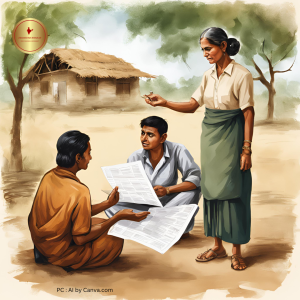
One day, while visiting the district town for a medical check-up, Ramu Kaka overheard a conversation at a tea stall. A young man was explaining to an old woman how she could get information about her pension using something called “RTI.” Intrigued, Ramu Kaka listened intently. The young man elaborated on the RTI Act 2005, explaining that it allows any Indian citizen to ask for information from government bodies. He mentioned its simplicity: just write a letter, pay a small fee, and government agencies must provide the information within 30 days.
A light bulb, far brighter than any solar street light installed in Roshanpur, went off in Ramu Kaka’s mind. This was it! This was how he could get answers. With newfound determination, he sought help from a literate young neighbour, Raju, who worked as a clerk in the nearby town. Raju patiently explained the process and helped Ramu Kaka formulate his application.
Unveiling the Truth: A Strategic RTI Application
Ramu Kaka’s RTI application was meticulously crafted. Addressed to the Public Information Officer (PIO) of the Gram Panchayat, with a copy marked to the Block Development Officer, it contained precise questions:
- Total budget allocated for the Solar Street Light Scheme in Roshanpur Gram Panchayat.
- Number of solar street lights sanctioned for installation in Roshanpur village.
- Details of the contractor awarded the tender, including company name, owner, and contact information.
- Copies of work orders, purchase invoices, and payment receipts related to the scheme.
- Dates of installation for each street light and details of the official who certified completion.
- Inspection reports of the installed solar street lights.
He carefully paid the nominal fee and submitted the application. The waiting period of 30 days felt like an eternity, but Ramu Kaka held onto hope.
The Elephant in the Room: The RTI Response
When the response finally arrived, sealed in an official envelope, Ramu Kaka’s hands trembled. With Raju’s help, he carefully reviewed the documents. What he found confirmed his worst fears, yet also filled him with a surge of righteous vindication.
The official records stated that the entire sanctioned number of solar street lights had been installed across all lanes of Roshanpur. The invoices showed payments made to a contractor named “Surya Urja Solutions,” listing prices for high-quality, high-wattage lights. The completion certificates were signed, purportedly by a local engineer whose signature Ramu Kaka barely recognized. The inspection reports lauded the “excellent quality” of the work.
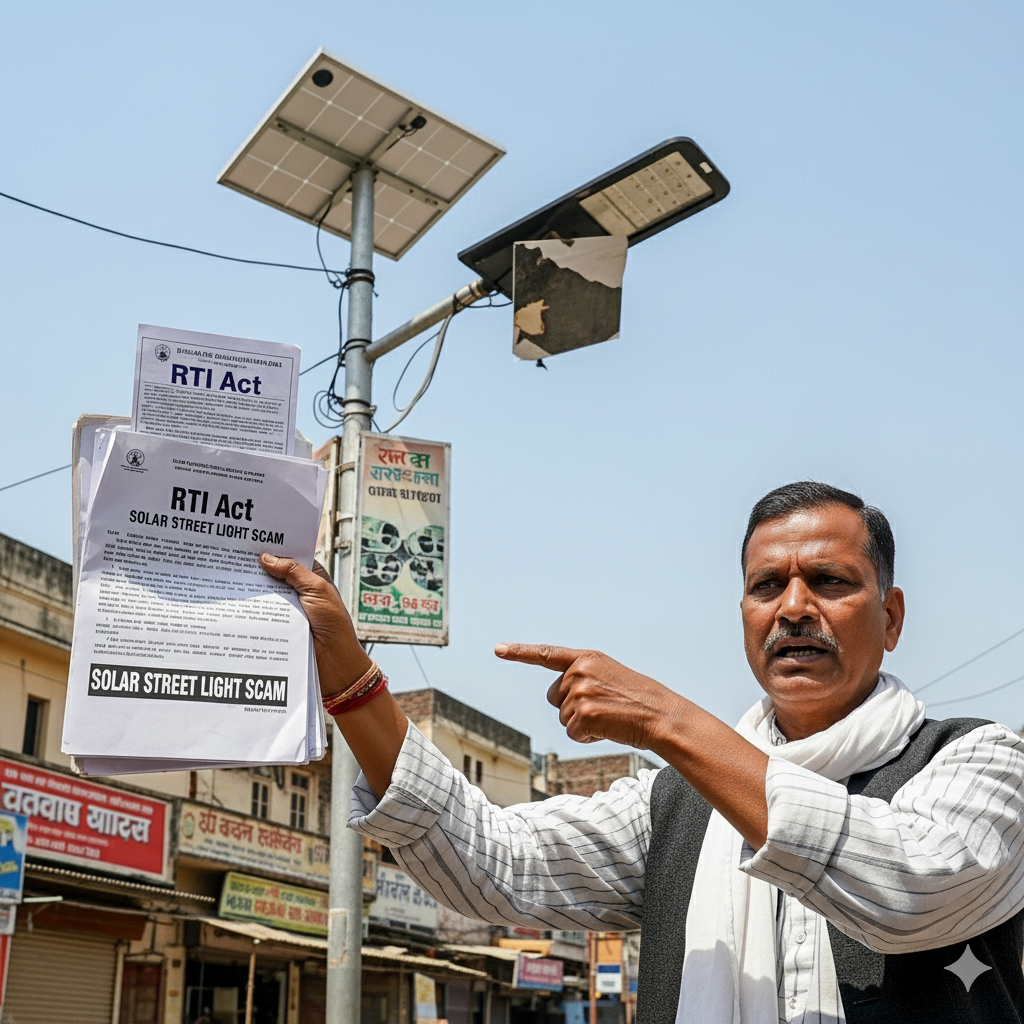
However, the reality on the ground told a vastly different story. The number of installed lights was barely half of what was claimed. The quality was abysmal. “Surya Urja Solutions” was a name no one in the village had ever heard of, and its address was a dusty, deserted plot on the outskirts of the district town. The engineer whose signature appeared on the certificates was often absent from the village and had never conducted a thorough inspection. It was a classic case of inflated bills, substandard products, and ghost installations – a clear solar street light scam.
Beyond the Documents: Igniting Change
Armed with undeniable evidence, Ramu Kaka didn’t stop there. He gathered a few trusted villagers, including Raju, and showed them the documents versus the stark reality. Outrage quickly spread throughout Roshanpur. This time, however, it was an informed outrage.
They approached the District Magistrate, presenting the RTI documents as irrefutable proof. The DM, seeing the concrete discrepancies and the meticulous work of a common villager, immediately ordered a high-level inquiry. Local newspapers picked up the story, highlighting Ramu Kaka’s courage and the power of the RTI Act.
The investigation uncovered a deep web of corruption involving the Sarpanch, the Gram Panchayat Secretary, and several other officials who had colluded with the phantom contractor to siphon off funds meant for the scheme. Legal proceedings were initiated, and within months, the culprits were brought to justice. The misappropriated funds were partially recovered, and more importantly, the Solar Street Light Scheme was re-implemented correctly, this time with genuine, high-quality lights that truly brightened Roshanpur’s lanes.
The Lasting Impact of the RTI Act 2005
Ramu Kaka became a quiet hero in Roshanpur, a testament to the fact that courage combined with the right tools can dismantle even entrenched corruption. His story reverberated beyond his village, inspiring others in neighbouring communities to use the RTI Act for their own grievances.
The RTI Act 2005 is more than just a piece of legislation; it is a catalyst for change, a guardian of transparent governance, and a formidable weapon in the hands of the common man. It democratizes information, shifts power dynamics, and holds public servants accountable. Ramu Kaka’s journey from a hopeful villager to an inadvertent whistle-blower underscores the profound impact this act has had, proving that in a democracy, the true power rests not with those in authority, but with an informed and empowered citizenry willing to ask the right questions.